High-Pressure Grinding Roll (HPGR)
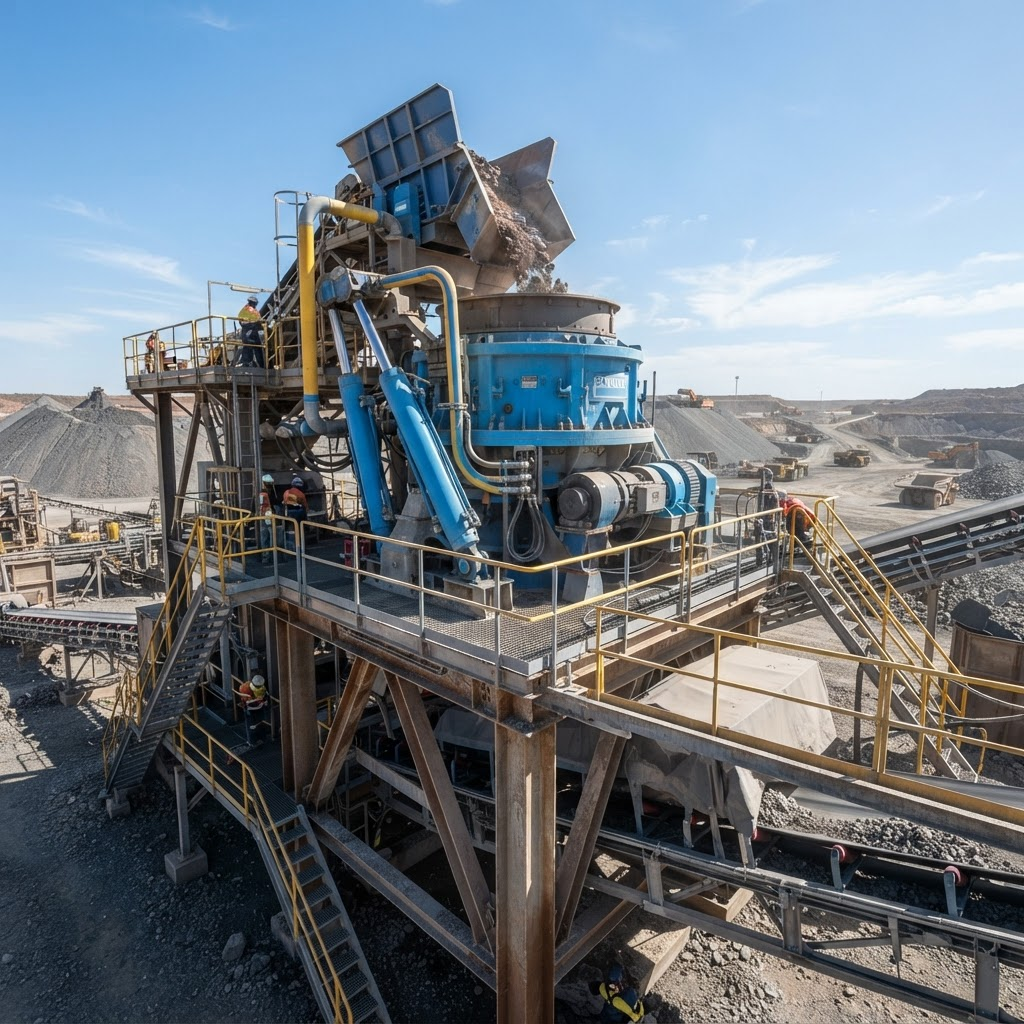
The High-Pressure Grinding Roll (HPGR) is a new type of highly efficient and energy-saving crushing equipment developed in the mid-1980s. In the early stages of its industrial application, limited by roll-surface wear-resistance technology, it was primarily used in the cement industry. With the maturation of key technologies—such as wear-resistant stud roll surfaces, hydraulic coupling drives, and direct roll-shaft connections via universal joint shafts—it has been successfully applied in metal mines both domestically and internationally, especially iron ore mines, to crush metal ores of medium-to-high hardness. HPGR features large throughput, fine product particle size, high crushing efficiency, and high equipment operating rates, making it ideal equipment for fine and ultra-fine crushing of iron ore. Combining the historical production practices of iron ore processing, this paper reviews HPGR crushing processes and their industrial applications in iron ore comminution.
1. Structural Features and Working Principle of HPGR
Although similar in structure to double-roll crushers with two working rolls, HPGR operates on a completely different crushing principle. HPGR consists of a frame, high-pressure working rolls, a hydraulic system, and a feeding system. The key working components are a pair of high-pressure rolls arranged in parallel that rotate in opposite directions. Each roll is driven by a motor via a planetary gear reducer; the fixed roll is stationary, while the movable roll moves along horizontal guide tracks. The hydraulic system on the movable roll shaft provides extremely high working pressure (up to 300 MPa) to the roll surfaces.
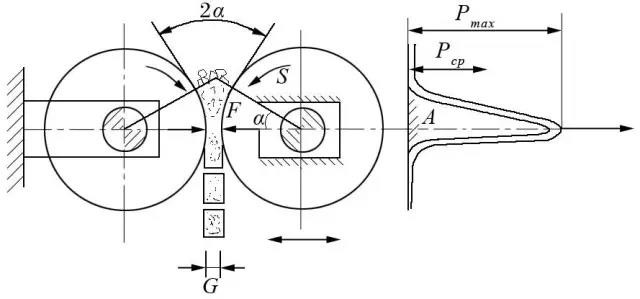
The operating principle of HPGR is interparticle crushing (bed crushing), proposed by Prof. Schönert in Germany in the late 1970s, which has since guided the design and retrofit of energy-efficient crushing equipment. During operation, feed material enters the crushing cavity between the two rolls through an adjustable gate under choke-feeding conditions. Driven jointly by the weight of the material column and the opposing rotation of the two rolls, the feed is forced into the narrowing crushing cavity and compacted. Upon reaching a certain pressure, the material breaks and is discharged as dense, micro-fractured flake-like cakes. These cakes contain a high proportion of fine and micro-fine particles alongside internal micro-cracks, significantly reducing their mechanical strength and indirectly boosting subsequent mill throughput and grinding efficiency. The interparticle crushing principle of HPGR is shown in Figure 1.
Figure 1: Diagram of Interparticle Crushing Principle in HPGR
2. Typical Crushing Flowsheets
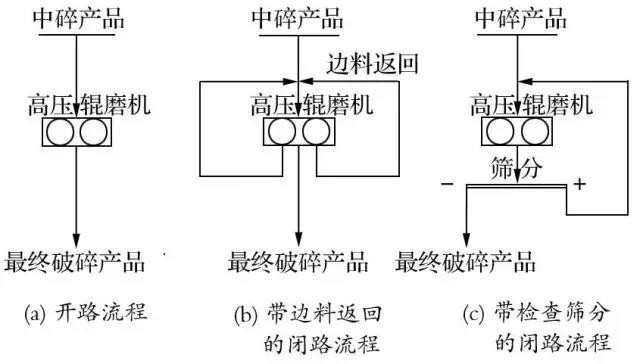
In conventional crushing flowsheets, HPGR is mainly used as tertiary fine crushing equipment or quaternary ultra-fine crushing equipment within a three-stage, single closed-circuit process. Typical flowsheets fall into open-circuit and closed-circuit processes; closed circuits are further divided into edge-recycle closed circuits and check-screening closed circuits. The typical crushing flowsheets are shown in Figure 2.
Figure 2: Typical HPGR Crushing Flowsheets